Baptism, wedding, funeral. During life, a person goes through a number of milestones and rituals that change our social status. Baptism or naming is perhaps the most important in life. Here you will learn more about the significance of baptism based on the research and collections of Nordiska museet.
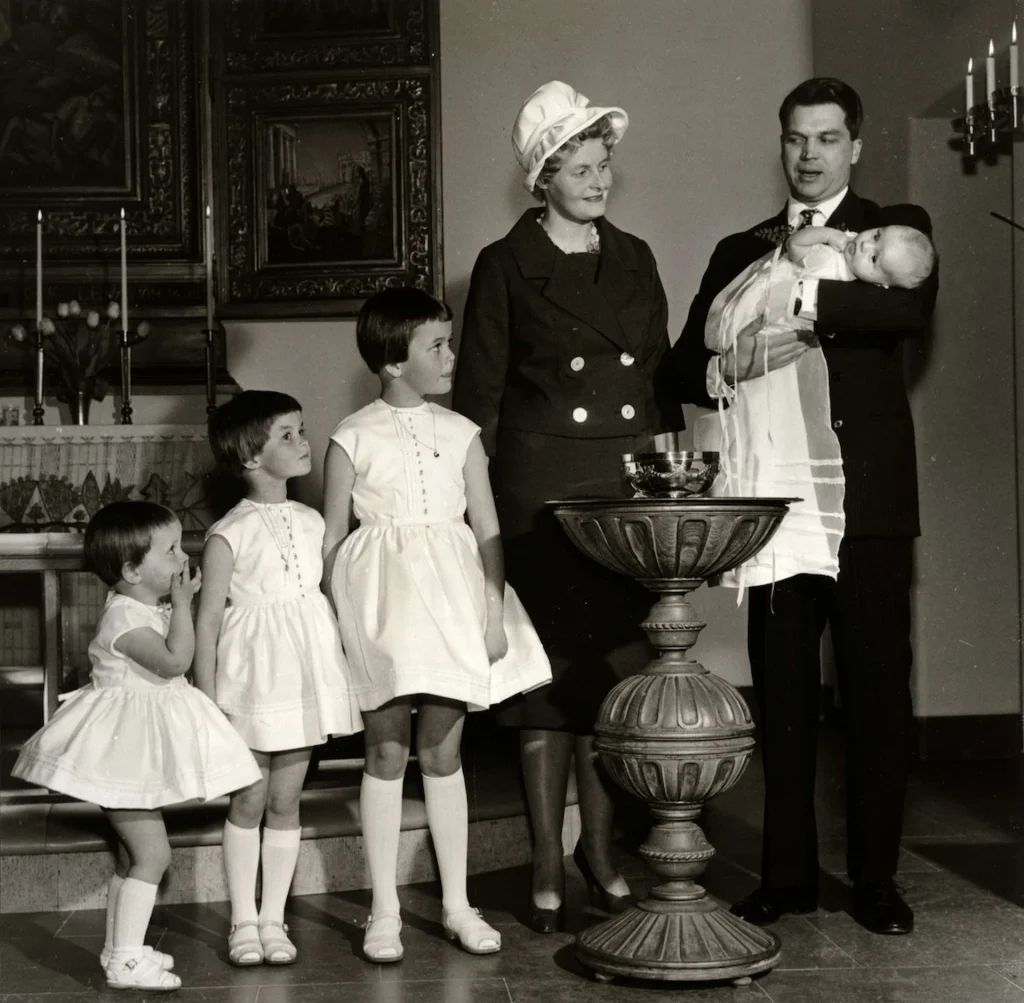
Family photo from K W Guller's archives, the baptism of Pia 1956. Photo: K W Gullers, Nordiska museet
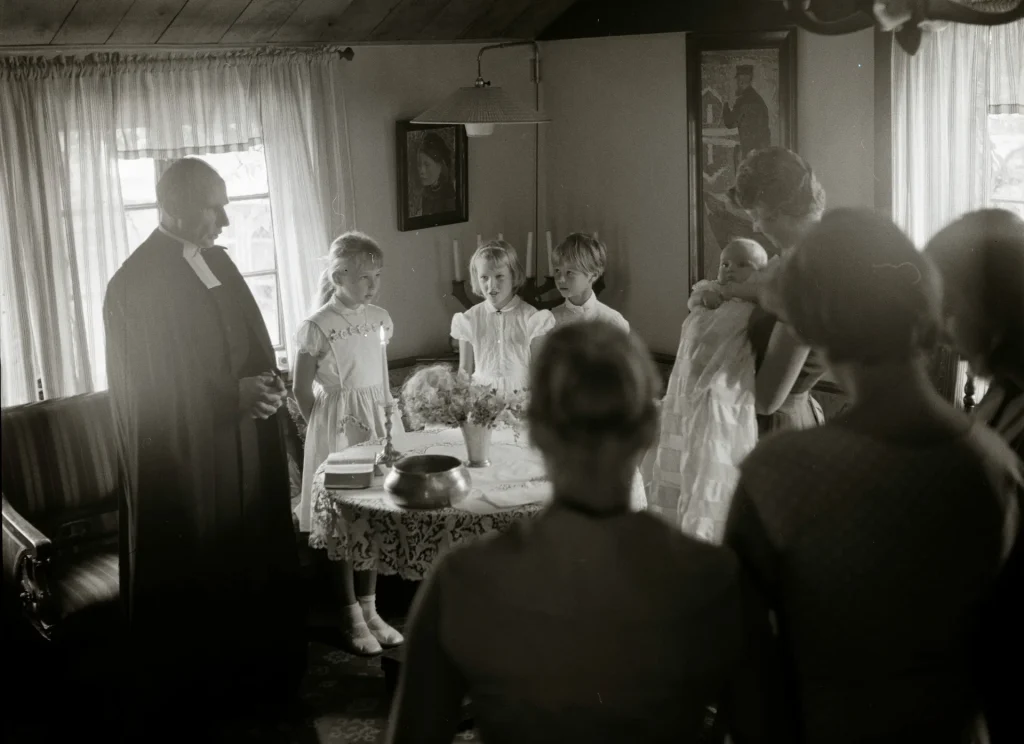
Dopceremoni i kyrka, 1960-tal.Foto: Karl Heniz Hernried, Nordiska museet
Of all life’s celebrations and rituals, baptism or the naming ceremony is perhaps the most important. The tiny infant becomes a human being and part of the social community and structure. For Christians, baptism marks entry into the congregation, a parallel to the social community and order.
In the Nordic countries, baptism is, from a cultural-historical perspective, strongly associated with the Christian Protestant liturgy. However, we need to understand the significance of baptism from many different perspectives.
The ritual of baptism is changing
According to the Church of Sweden, fewer children are being baptised in Sweden today. During the 20th century, the significance of church baptism began to change and the number of baptisms declined. There are several explanations for this, but one is linked to the church’s diminishing role in people’s everyday lives. As attitudes towards the Church’s liturgy have changed, the rituals have also evolved.
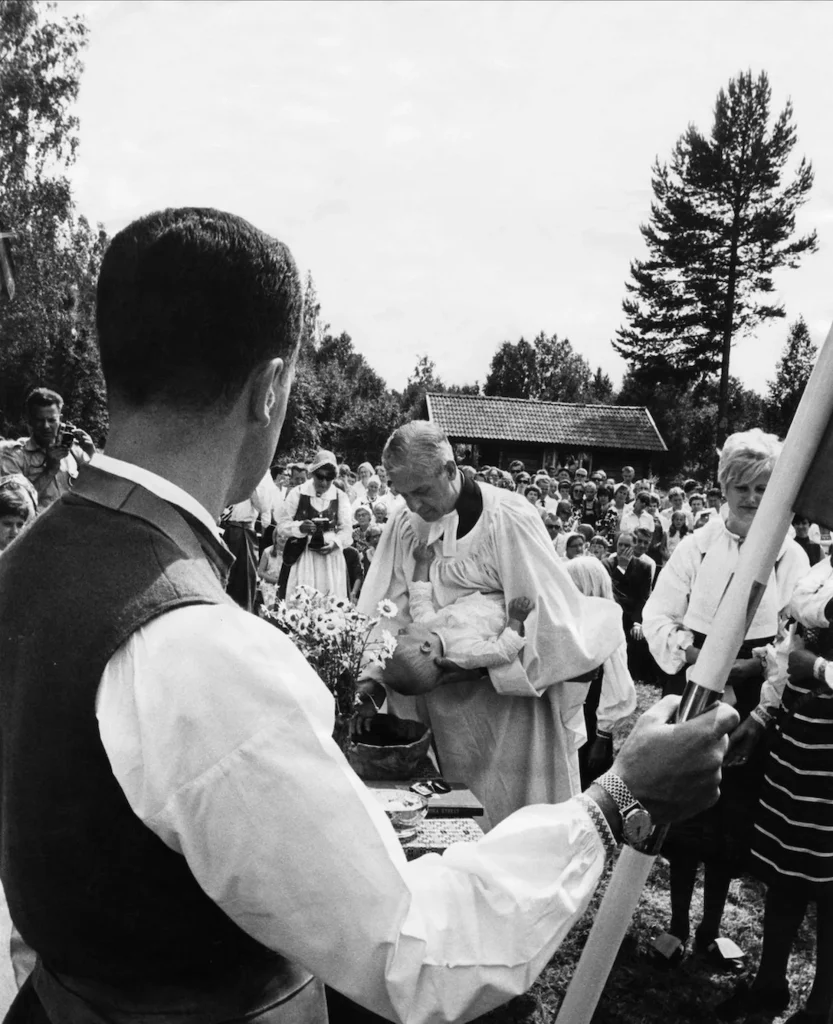
Nowadays, baptisms take place in various locations, but 35 per cent of newborns are baptised in a church building (Church of Sweden statistics). During the 1970s, 80 per cent of baptisms took place in church.
Today, a naming ceremony is the established term for a non-church ritual that may take place at home or in another location. A civil officiant, often a relative or friend, may stand in for the priest.
Baptism in a chuch, 1960's.Photo: Karl Heinz Hernreid, Nordiska museet
Family photo from K W Guller's archives, the baptism of Pia 1956. Photo: K W Gullers, Nordiska museet
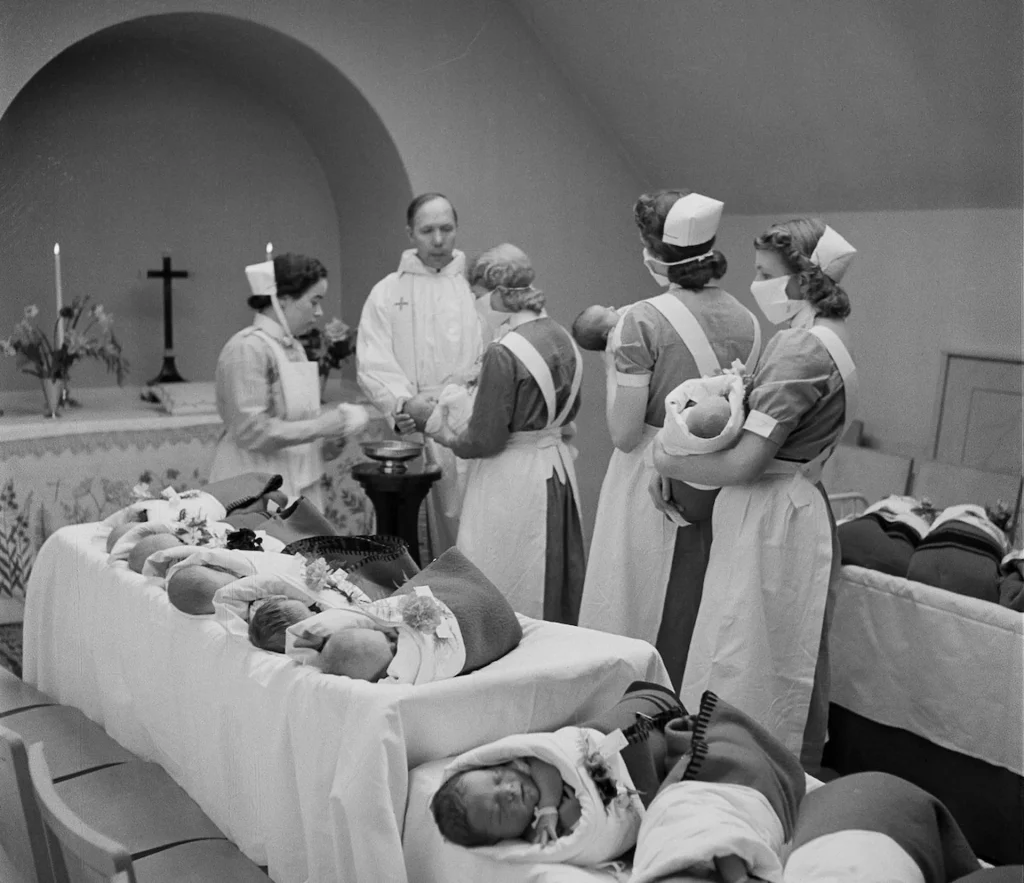
Baptism in the chapel of Södra maternity ward, 1940.Photo: Gunnar Lundh, Nordiska museet.
Baptism for two in Rönnäng's church.Photo: Erik Liljeroth, Nordiska museet.
Up until the 19th century, baptisms took place in church; thereafter, they gradually moved into people’s homes. One reason for this was that the infants and their mothers suffered from the cold in and on the way to the church. Although baptisms increasingly took place in people’s homes during the 20th century, a priest was present to perform the baptism in accordance with church rites.
An unbaptised person was not allowed to be buried in the churchyard and could not enter heaven after death. Baptism brought God’s protection and purification from sin.
The significance of baptism
Baptism and naming ceremonies have always held great significance for people, not only from a religious and ecclesiastical perspective but also because of popular beliefs about the child and the beginning of life. Both baptism and modern naming ceremonies contain elements of ecclesiastical liturgy and folk beliefs concerning good and bad fortune, social influence and power, family and society.
Today, most people regard the naming ceremony as the essence of baptism. And in pre-industrial society, the naming ceremony was important, but secondary: in the Nordic countries and throughout the Christian world, baptism was first and foremost a prerequisite for attaining salvation after death. An unbaptised person was not allowed to be buried in the churchyard and could not enter heaven after death. Through baptism, one received God’s protection and purification from sin.
But it was believed that a name brought good qualities. It was common for names to be passed down from older generations. And it sometimes happened that sick children were given new names in the hope of turning their fortunes around, as an attempt to cure their illness when nothing else helped.
The great importance attached to one’s name is evident from the fact that people celebrated name days rather than birthdays. It was more important to have been baptised – and thus to be a child of God – than the day on which one was born.
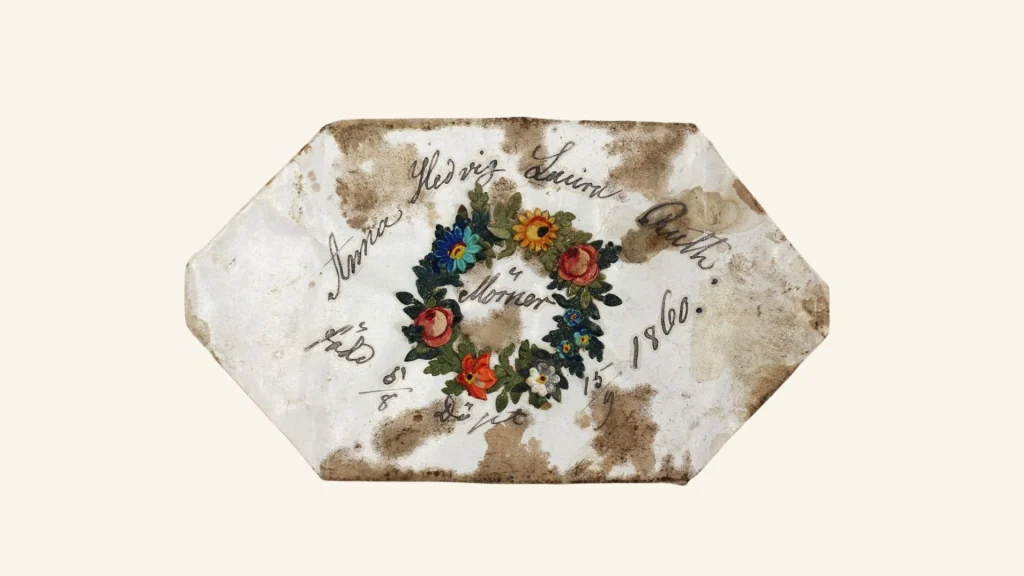
A christening sweet with the inscription: ‘Anna Hedvig Laura Ruth Mörner, born 5 August, christened 15 September 1860’, from the collections of Nordiska museet.Photo: Nordiska museet
Risks for the mother
As soon as a pregnancy was confirmed, the expectant mother was not allowed to attend church, as she was considered unclean; in some cases, she was even thought to be a harbinger of evil.
This is why the custom of church readmission was important. It was a ritual in which the mother was readmitted to the church community after the christening. The period during which a woman was not allowed to attend church could be far longer than nine months.
Furthermore, a pregnant woman was considered to be particularly vulnerable to evil forces. Anyone who stared at a pregnant woman, for example, risked causing her to fall ill.
If a woman died in childbirth, it was said that she would return as a ghost to swaddle her baby at night. For this reason, sewing thread, scissors and other sewing supplies were placed in the woman’s coffin so that she could sew a swaddle for the baby. In other words, it was believed that if a woman who had died in childbirth returned as a ghost, it was to continue caring for her newborn child. And that if sewing supplies had not been placed in the coffin, it could bring misfortune.
Risks to the foetus and the baby
The foetus, too, was regarded as being at risk of danger, illness and deformities. If a pregnant woman caught sight of a hare, there was a risk that the child would be born with a cleft lip. If a pregnant woman was present at the slaughter of an animal, the child was at risk of falling sickness (epilepsy).
In some places, the foetus was considered to be particularly vulnerable every other month or during the final weeks of pregnancy; in others, the early stages of pregnancy were also regarded as so-called critical months.
If a pregnant woman caught sight of a hare, there was a risk that the child would be born with a cleft lip.
‘Bortbytingar’ or swaps
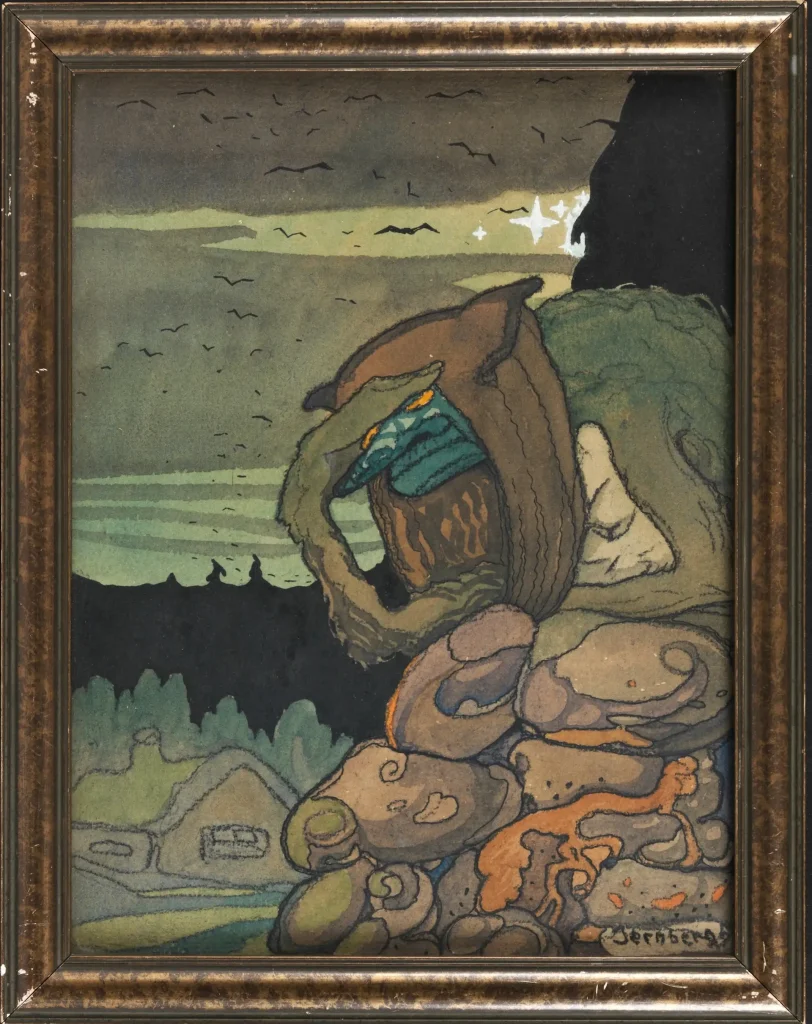
One of the most widespread images of the danger to a child is that of trolls who abduct human children and swap them for their own. The child was considered particularly vulnerable before baptism, as it lacked God’s protection.
In popular belief, the swap is seen as a way for the trolls to provide their child with the upbringing and care amongst humans that they themselves could not provide.
The methods used to persuade the troll mother to swap the child back involved tormenting it so that its cries would force her to come and retrieve her child.
The legends tell of children, believed to be ‘swapped children’, that is, troll cubs, who were placed in ovens or on the manure heap on New Year’s Eve.
But there were protective measures:
to keep the fire burning until the christening
to wash the baby with water fetched before the birth, otherwise Näcken might take the baby
beer could also be used, if the water had not been fetched before the birth
Magical techniques for a child’s happiness
In folk tradition, there were several ways of ensuring a child’s happiness in life through magical practices.
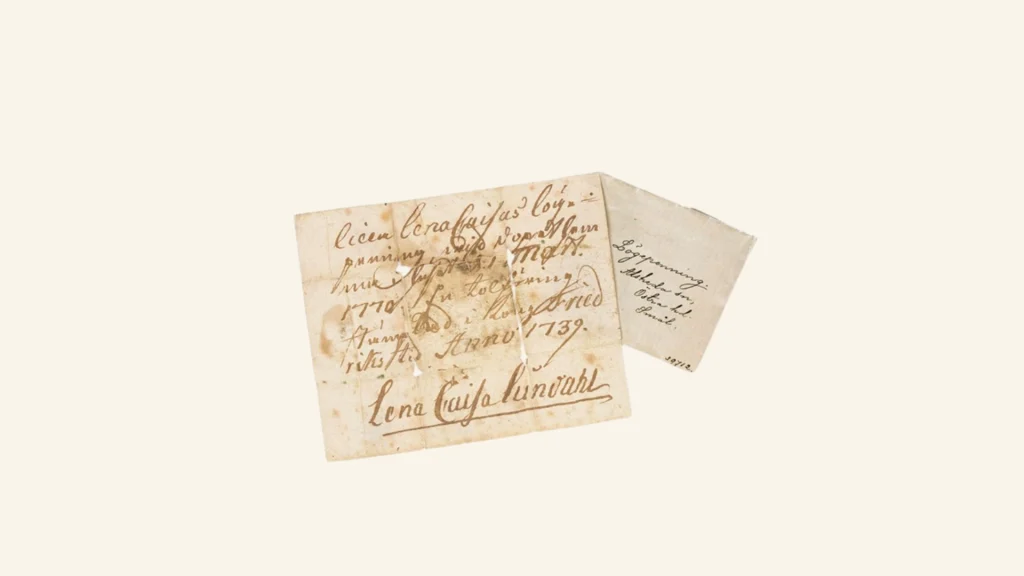
In Småland, the terms lögepenning and lögebrev were used. The word löga means to bathe and refers here to the child’s first bath. A coin was placed in the bathwater, which was kept together with a lögebrev bearing the date of birth and the child’s name.
Elsewhere, a wedding ring or inherited silver objects placed in the bathwater worked well.
An egg yolk in the bathwater gave the child a fine complexion and a beautiful appearance.
Once the child had been washed, the first weighing took place. If this was done immediately after birth and then on three consecutive Thursday evenings, the child would grow well and become successful.
Shortly after giving birth, a mother could place the baby on a threshold and stamp lightly six times with her right foot and three times with her left foot, saying, ‘I tread upon you with my foot. I cure you of nine kinds of dangerous illnesses.’
When the mother returned home after the christening, she could break some reeds and whip the baby; this would prevent it from becoming a crybaby.
Baptism in pre-industrial society
Given the high infant mortality rate, it was important to baptise the child quickly so that it would not remain a pagan and be damned for ever. This explains the practice of so-called emergency baptisms, which took place outside the church and could be performed by people other than the priest.
The baptismal rite itself naturally followed the Church’s liturgy, but also incorporated elements of popular belief:
The child was usually taken to the church by the godmother, as the mother was not allowed to be present in the church before the christening.
Alongside the godmother was the hättgodmother, whose role was to put on and take off the child’s bonnet before and after the christening.
The godmother ensured that the child held a coin in one hand and breadcrumbs in the other, which was believed to bring wealth and a good livelihood.
At the christening, the priest met the family at the church entrance, where the father had to remain during the ceremony.
The priest made the sign of the cross over the child and read a prayer for protection against the Devil. He placed a few grains of salt in the child’s mouth so that it might ‘take in the salt of wisdom’.
The child was immersed in the holy water, a candle was placed in its hand, and the godparents presented gifts.
The child was led out of the church by the godmother, who touched the child’s head against the church wall so that it might be spared future headaches.
Once home, the godmother handed the child over to the father, saying, ‘Here you have a Christian instead of a heathen’.
In rural areas, the baptism was often followed by a celebration, known as a barnsöl, or baby beer.
The role of godparents
In rural communities, godparents played an early role in overseeing the child’s moral upbringing. At the same time, we know that the choice of godparents was based on the godfather’s social and economic status. It was also not uncommon to have several godparents, sometimes almost a dozen.
The ideal was for two couples – one married and one unmarried – to act as witnesses at the christening and thus as godparents. Godparents were expected to give gifts to the child; a common gift in the past, as well as today, was a silver spoon. The hope was that godparents would contribute in various ways to the child’s happiness and prosperity.
The role of godparents has varied throughout history, but today it remains a common feature of a child’s early life. Nowadays, the child’s closest circle of friends, relatives or even neighbours are often asked to become godparents, a role that is regarded as an honour.
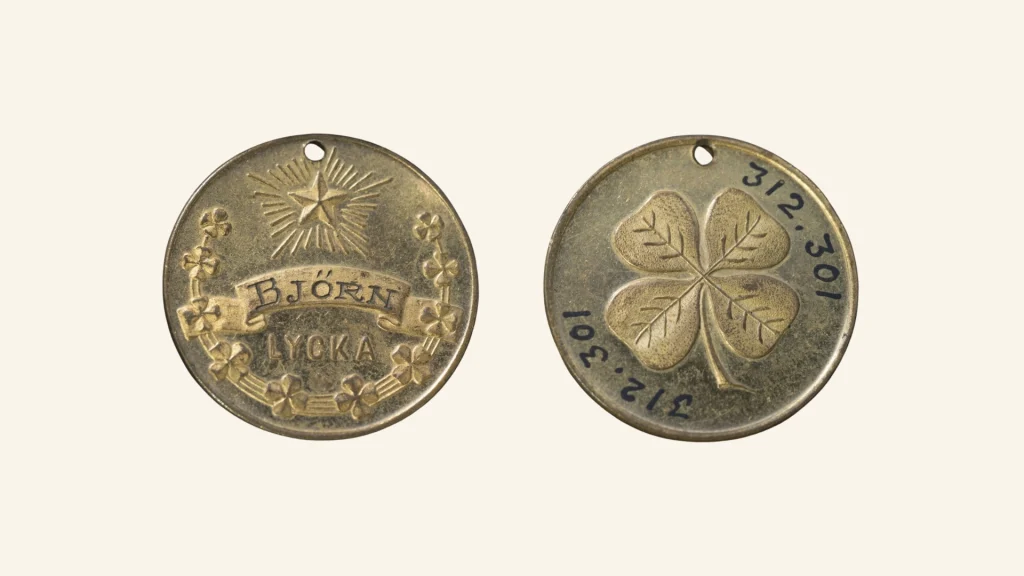
Christening gift for Björn Bergengren, lucky coin NM.0312301, second half of the 20th century.Photo: Nordiska museet
Baby showers and modern-day birth rituals
The period surrounding a child’s birth and early years appears to be characterised by efforts to bring the child happiness and ward off misfortune, involving rituals and events of a more or less magical nature.
Many attitudes and rituals in our contemporary society bear traces of earlier times, even though people’s circumstances have changed dramatically. A key aspect is that the rituals surrounding birth and the early years of life express a desire for happiness and success. Baptism as a form of ceremony remains. It often takes place privately in people’s homes, and the naming itself is now regarded as the most important part of the ceremony.
Some ritual elements are entirely new. Baby showers began to appear in the 1990s, as did dummy trees. Parents who allow their child to leave their dummies in the tree are simultaneously marking a transition to a new stage of life.
Fem föremål
1
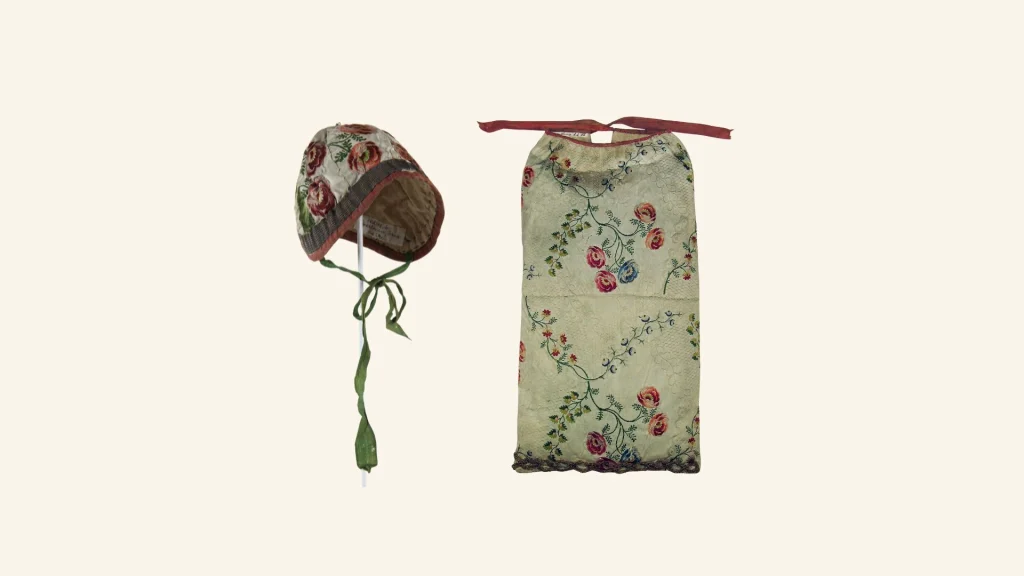
Christening gown, NM.0105448B
1
Christening gown, NM.0105448B
A christening gown made of light grey silk brocade with a meandering floral pattern in various shades of red/pink, blue and green, with touches of yellow and white; a design dating from around 1750 that was probably originally a dress.
At the top, the bag is slightly gathered and ruffled with a border of pink silk ribbon that fastens with a tie at the back; there is a slit at the back. The lower edge is decorated with a meandering border of gold thread in chain stitches. The bag is lined with white, fringed cotton twill. The christening gown was worn in the 1830s.
A protective measure taken before baptism was the lögan, the first bath given as a symbolic purification before the child was immersed in the baptismal water. The lögepenning was a small gift that might be given to the midwife or the priest in connection with the bath. In this way, it served both as a token of gratitude and an expression of care for the little, as yet unbaptised child.
Nordiska museet’s collections contain the löge letter accompanying a lögepenning from Småland, given at the home baptism of little Lena Caissa on 1 March 1770. The coin itself has been stolen, as noted, but the letter bearing the child’s name remains.
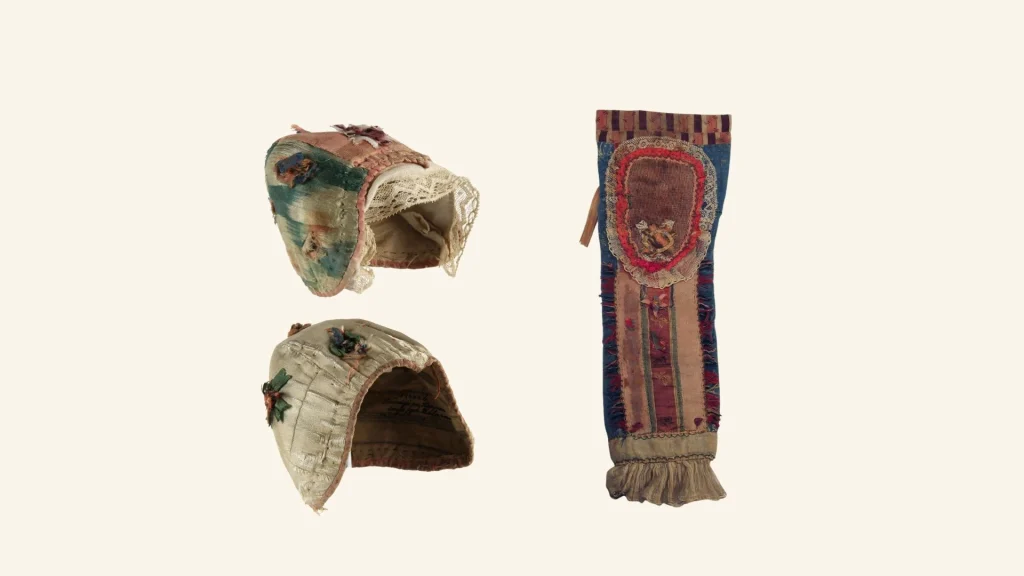
A christening gown and a boy’s bonnet (top) and a girl’s bonnet (bottom) from Hillersboda, Dalarna, which were acquired by Nordiska museet in 1887. The gown is made of blue silk fabric with a woven white floral pattern in an 18th-century style; on the chest is an oval patch of brown silk with a silk ribbon, lace and sequins. Cotton print around the neckline.
Boy’s bonnet made of white silk satin edged with pink silk ribbon. Girl’s bonnet with side panels and a central panel featuring a pointed peak at the forehead.
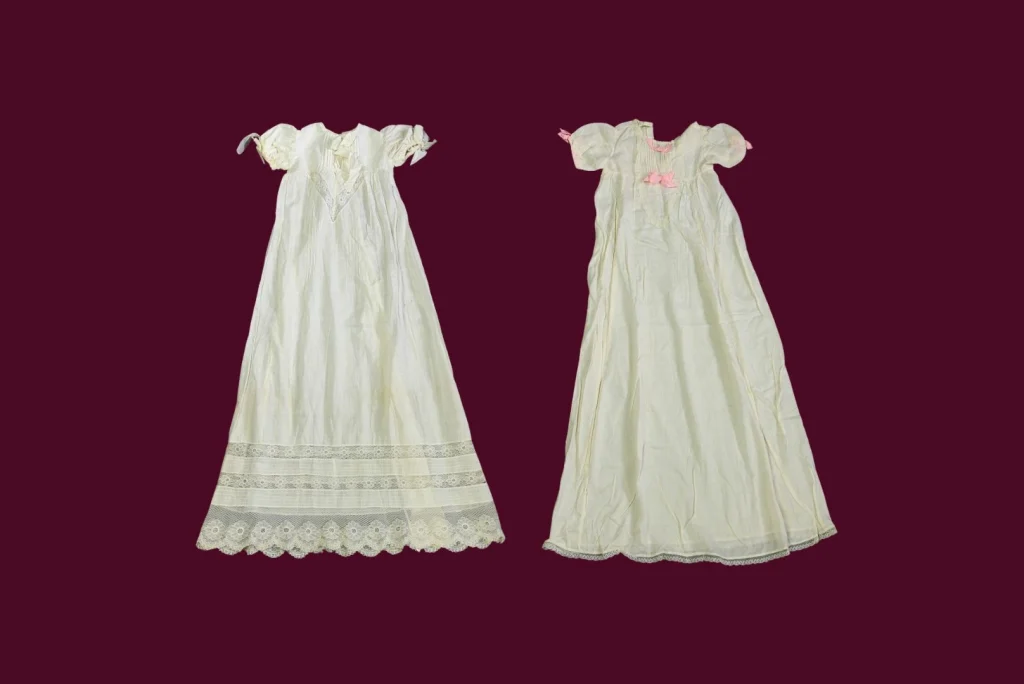
Two christening gowns from the same family in Falun, where the children’s grandparents ran Ahlzén’s tailor’s shop until 1947. The gown on the left was sewn by the grandmother in an early 20th-century style for her grandson Percy’s christening in 1944.
In 1946, twin girls, Anne-Marie and Marianne, were born. There was a rush to sew another christening gown. The children’s 16-year-old aunt, Stina Fågelberg, was asked to sew the newer gown, in a simple style typical of the period, with minimal decoration. The fabric is synthetic, something that became increasingly common during the war years.
The children’s mother was, at that time, a single working woman, so the christening was a simple affair in the hospital chapel at Falu Hospital shortly after the birth. According to the donor, the first-born twin, Anne-Marie, probably wore the dress from 1944.
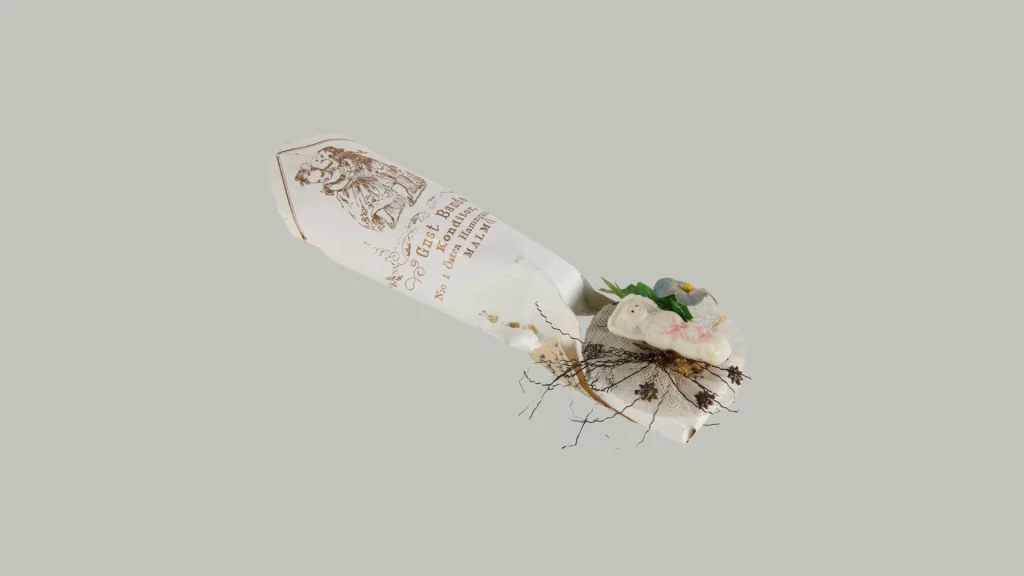
A sweet made by a confectioner on Östra Hamngatan in Malmö, wrapped in paper, fabric and tulle with gold-printed text. A christening sweet was a small keepsake, often consisting of a sweet treat in a beautiful wrapper.
This one, from 1883, was for Siri Louise Westerberg (donated to the museum in 1962).
As a museum of cultural history, Nordiska museet documents everyday life and festive occasions in the Nordic region. For example, we research: What do people celebrate, and how? What do the traditions and rituals of yesterday and today look like? And what role do they play in our social life?
We have been gathering knowledge about traditions since the late 19th century
Since the late 19th century, we have been documenting and gathering knowledge about traditions and rituals in people’s everyday lives and celebrations, which represent festivals and traditions. This knowledge takes the form of artefacts, photographs, folk memories and transcribed interviews featuring examples of rituals and traditions.
We have also collected and documented this material through fieldwork (that is, documenting celebrations on site), sending out questionnaires, interviewing people and, more recently, through digital collections.
Traditions change and are dynamic
Over the 150 years that the collections have been in existence, there have been enormous social changes in Sweden and the Nordic region. Traditions and social patterns are also dynamic and change: traditions are born, transformed and evolve in line with people, the times and the media. We continuously analyse the material in the light of both contemporary processes and historical circumstances.
Many factors shape and change celebrations
In short, it can be said that celebrations today reflect a multitude of influences from past social structures, from our own time, from migration, as well as social, economic and technological change.
Festivals and festive celebrations in the Nordic region are strongly influenced by the Christian faith, changes in society and values. Further factors include folk and supernatural- beliefs, folk religion and folk values that can be traced back to Nordic peasant society.
Over the 150 years that Nordiska museet has been gathering knowledge about traditions and rituals linked to festivals and special days of the year, there have been enormous social changes in Sweden and the Nordic region. Traditions are born, transformed and evolved in tandem with time and it’s people.
Ritual?
Over the past 150 years, research perspectives and concepts have also changed. A key fundamental concept is that of ritual. This refers to the practical observance – what people do in connection with a festival, tradition, specific day, time of year or event. Such as eating semlor, hiding Easter eggs, lighting candles in cemeteries or going ‘trick-or-treating’.
Rituals often involve symbols, such as the Christmas tree, the Midsummer maypole, waffles and semlor, or, for that matter, the crisps and dip enjoyed during Friday nights for the ultimate “fredagsmys”.
Tradition?
You could say that a ritual becomes a tradition when people attach particular value to the ritual and the celebration, without these necessarily having to be particularly old or widespread.
This definition, too, reflects the perspective of academic research. However, in everyday speech, the terms ‘ritual’, ‘tradition’, ‘festival’ and ‘custom’ are often used interchangeably. When we talk about traditions here, we are generally referring to rituals that are particularly valued; Christmas celebrations are one example.
Religious festivals
Another important term is ‘festival’ (högtid), which refers to rituals that are more closely linked to religious calendars. In the Nordic countries, the Christian calendar has dominated, but other religious calendars play an important role as well.
The boundary between religious calendar rituals and secular rituals appears to be becoming increasingly blurred, reflecting the secularisation of society. Most people in Sweden celebrate religious festivals without paying attention to their religious connection.
Annual festivals and life-cycle celebrations
In addition to the church calendar, festivals have historically been shaped by the rhythm of the farming year and agriculture. These are known as annual festivals or calendar rites.
Many festivals are linked to the human life cycle, where church rites have been, and remain, of great significance.
However, as society changes, so does the significance of these rituals. Although many people are still baptised today, it is not uncommon for this to take place through non-church naming ceremonies.
Ever-changing and dynamic
One of the most important insights into rituals and traditions to emerge from research is that they change. Certain particularly transformative social changes have left a clear mark on both everyday life and on rituals and festivals.
Perhaps the most significant from a cultural-historical perspective are the role of the church, as well as urbanisation, democratisation, the welfare state and the pursuit of social justice.
Contemporary life and tradition
As the Nordic countries became increasingly urbanised, economic conditions changed. People were no longer producing goods simply to provide for themselves. The family was transformed into a unit of consumption, able to purchase all the goods marketed in connection with festive occasions.
Traditions and festivals follow people’s movements between communities. Some are upheld, others fade away, and some take on a different meaning.