Baptism, graduation, wedding and funeral. During life, a person goes through a number of milestones and with them, rituals that indicate changes in our social status. What does funerals and the view of death look like historically and in our time? Here you will find out more based on the collections and research of Nordiska museet.
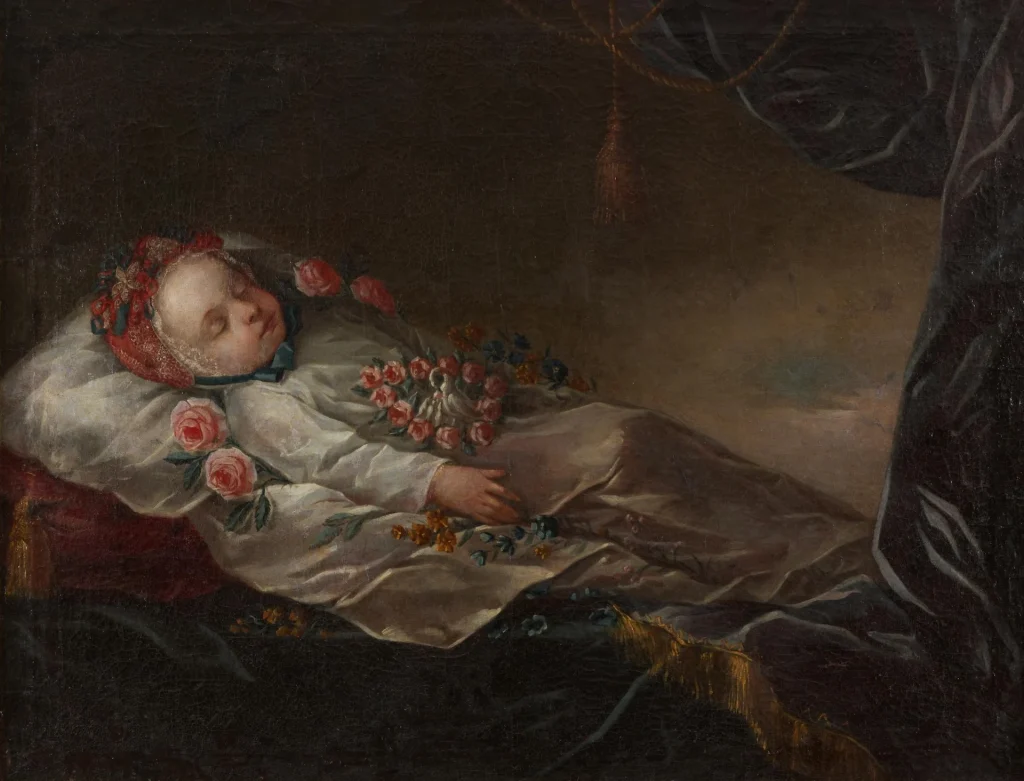
Oil painting of a deceased child. Photo: Nordiska museet
While baptism begins our social journey, a funural marks its end. That is why it is one of the most important rituals and celebrations in a person’s life, culturally and in our time.
Views on death— the end or the beginning
Attitudes toward the deceased and toward death itself vary throughout history and around the world. For those who believe in an afterlife, a funeral is a preparation for the next stage. In the Christian worldview, the soul leaves the body to attain bliss in heaven. For non-believers, a funeral is more about remembering the deceased and serves as a way to recount the deceased’s life story and journey.
Funerals vary throughout history and around the world
The ways of burying the dead also vary. In some societies, the body is cremated; in others, it is buried in the ground. In some cases, the body is left to dry on a rack while others a body is left to decompose on the ground. There are also traditions where the body is exhumed after a year, dressed in festive clothes, and celebrated one last time with relatives.
Life and death in rural societies
In the Nordic agricultural society, mortality rates were higher than they are today. Many people died from diseases that no longer pose a threat, poor hygiene, or a lack of food and medicine. Anyone who managed to reach the age of 50 was considered old.
For a long time, children were believed to have a special place in heaven
Infant mortality was particularly high. Many children died before the age of 10. Parents mourned and commemorated their children with simple wooden crosses, memorial plaques, funeral wreaths and funeral crowns. These might be hung in the church or kept at home as a memento. For a long time, children were believed to have a special place in heaven. Baptism was therefore very important, for if a child died without being baptised, it could not attain salvation.
In an attempt to secure a place in heaven for their stillborn children or miscarried foetuses, mothers would place them in small wooden boxes and lay them as close to the consecrated ground as possible. Foetal coffins have been found in churchyard walls, in church attics, in ventilation shafts and beneath church floors. Throughout the Nordic region, there have been instances of such coffins being smuggled into the coffin of a deceased person or buried in an open grave.
A cheerful wake, with laughter, games, dancing and beer, was believed to help the deceased reach the Kingdom of Heaven and find peace
A wake to protect the soul of the deceased
Before the funeral, people kept vigil over the deceased to protect their soul from evil forces. The body was washed and dressed in ceremonial attire or their finest clothes. The eyes and mouth were to be closed to symbolise a peaceful, heavenly sleep. A cheerful wake, with laughter, games, dancing and beer, was believed to help the deceased reach the Kingdom of Heaven and find peace. In a time rife with war and death, these vigils often degenerated into full-blown celebrations.
Funeral traditions in the Nordic countries
Christianity has been the dominant religion in the Nordic region for over a thousand years. In Christian tradition, it is important that a funeral is conducted properly. There are many legends in Swedish folklore about how a poorly conducted funeral has led to the deceased becoming a ghost and returning to have the mistake rectified. Perhaps the coffin was placed at an angle, or the deceased was not given a coin to place over their eyes (a way of keeping the eyelids closed). If anyone saw their own reflection in the eyes of the deceased, it was said to bring death.
Memorial services and obituaries
In the Christian tradition, it is the individual, preferably baptised, who is to meet God. But death was a collective concern. During Sunday High Mass, the priest would read out the names of those in the parish who had died, for the benefit of the whole congregation. In earlier times, church bells rang for the dying, and later, so-called soul bells rang for the dead. It was not until the mid-19th century that obituaries first appeared in newspapers. They did not become commonplace until the mid-20th century.
Anonymous funerals for the unbaptised and those who have taken their own lives
However, some were buried anonymously. Stillborn babies, people who had taken their own lives, murderers and other stigmatised individuals were not allowed to be buried in consecrated ground, but were given a place outside the churchyard or on its outskirts.
Stillborn babies, people who had taken their own lives, murderers and other stigmatised people were not allowed to be buried in consecrated church ground
Suicide was a very serious matter and was associated with both shame and guilt. According to Christian theology, this meant that the deceased would not go to heaven. On the contrary, there was a high risk that the deceased would become a damned soul, a ghost.
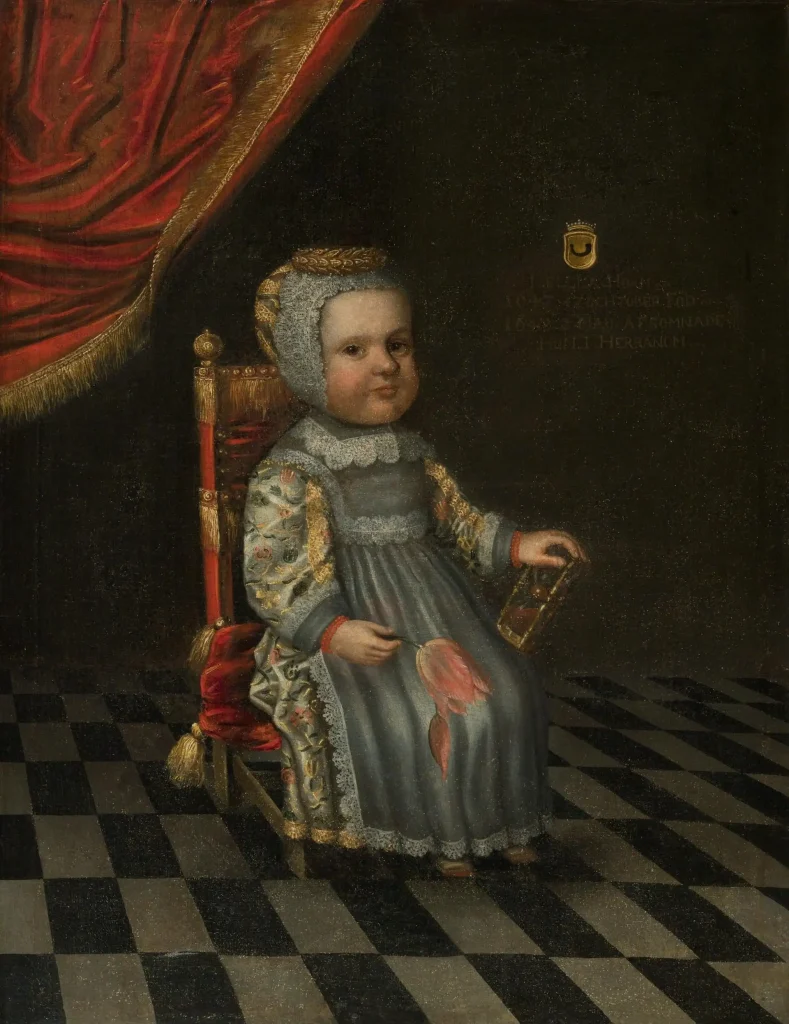
Helena Horn of Björneborg, depicted as alive after her death at the age of six months in 1648. NM.0191542.Photo: Karolina Kristensson, Nordiska museet
A nobleman’s funeral in the 17th century
During the 17th century, a nobleman’s funeral was a lavish celebration that showcased the nobility’s exalted status. Preparations for the funeral of Field Marshal Gustav Horn took three years. They included expensive mourning garments, ornate banners, a richly decorated coffin, a beautiful pall, engraved armor, and a printed funeral sermon. During a long procession through Stockholm to Jakobs church, the bells rang eight times.
In the late 17th century, the ostentation and luxury—which had taken on unreasonable proportions—were banned by specific regulations against extravagance.
During the 17th century, the tradition of portraying the recently deceased, post mortem, began to appear in art. The nobility portrayed their deceased children in paintings depicting them as alive, but wilted flowers or hourglasses with the sand having run out serve as symbols that they are no longer alive. The oil painting depicts one of Gustav Horn’s daughters.
Photographs commemorating those who have recently passed away
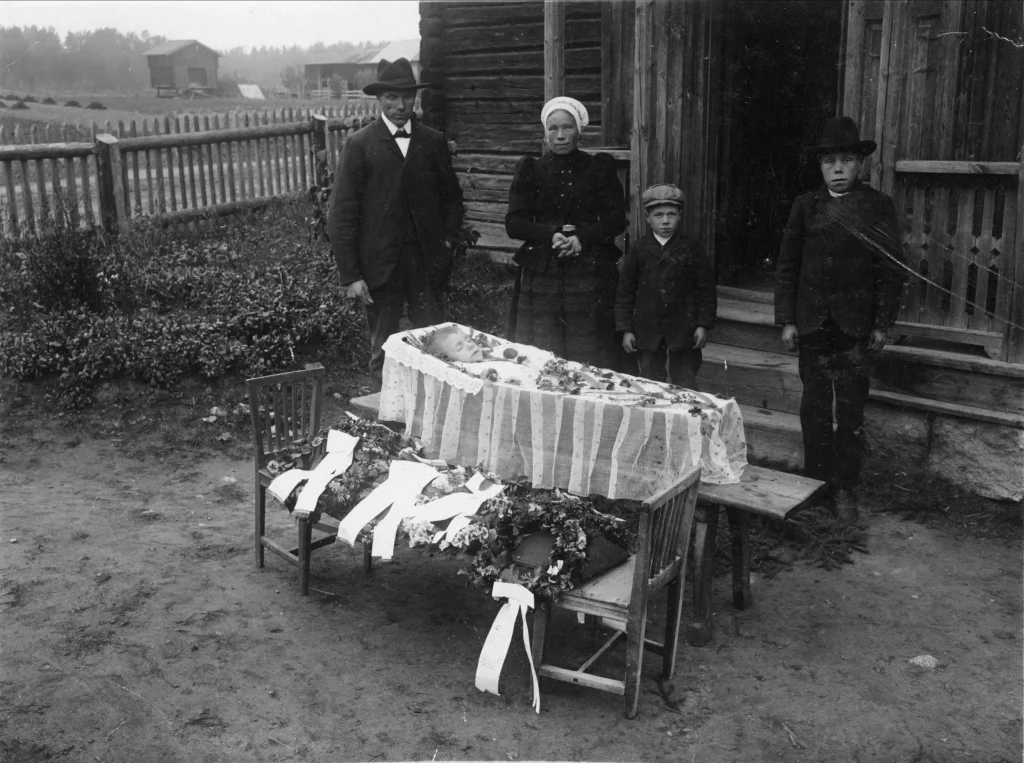
The tradition of taking portraits of the recently deceased was also common during the early days of photography, up until the mid-20th century.
The deceased lay in their bed or in an open casket so that family and friends could come by to say their final goodbyes. Before handheld cameras became common, it was often traveling photographers who took the portraits.
A memorial photograph of a child in an open casket, 1912.Photo: A Eriksson, Nordiska museets arkiv
Funerals in our time – tradition meets individualism
Funeral customs vary both globally and historically. Today, funerals look different than they did in the past. As the Nordic region became a destination for immigrants during the postwar period, it is now home to people with diverse traditions and religions. This has an impact on, and can pose challenges for, the church, the funeral industry, and, not least, the grieving families.
According to Jewish and Muslim traditions, a funeral should take place within 24 hours of death. But in Sweden, it can sometimes take up to a month before the funeral takes place. As a result, many families have to find compromises and solutions that work for both their traditions and societal customs.
Ceremonies that reflect personality and life journeys
It has also become more common to organize funerals in a more personal and individualized way. Today, many people choose to conduct the ceremony according to the deceased’s own wishes. Funerals in the early 2000s may include popular music, something that was practically unthinkable for most of the 20th century.
That and other personal touches are becoming increasingly common, and more and more people are choosing not to have a clergy member lead the ceremony. In this way, funerals increasingly reflect the life of the deceased.
Three objects
1
Coffin, 1640–1710, NM.0285615+
1
Coffin, 1640–1710, NM.0285615+
It is so small that it fits in the palm of your hand. The birch-bark fetal coffin was found in the cemetery wall at Odensjö Church in Småland. We do not know who placed it there, sometime during the second half of the 17th century. We do not know whether the mother was married or unmarried.
Perhaps it was an attempt by this woman to save her stillborn child from becoming a myling, a ghost in the form of a child who cries and calls out for its mother for all eternity.
Photo: Henrik Zeitler, Nordiska museet
2
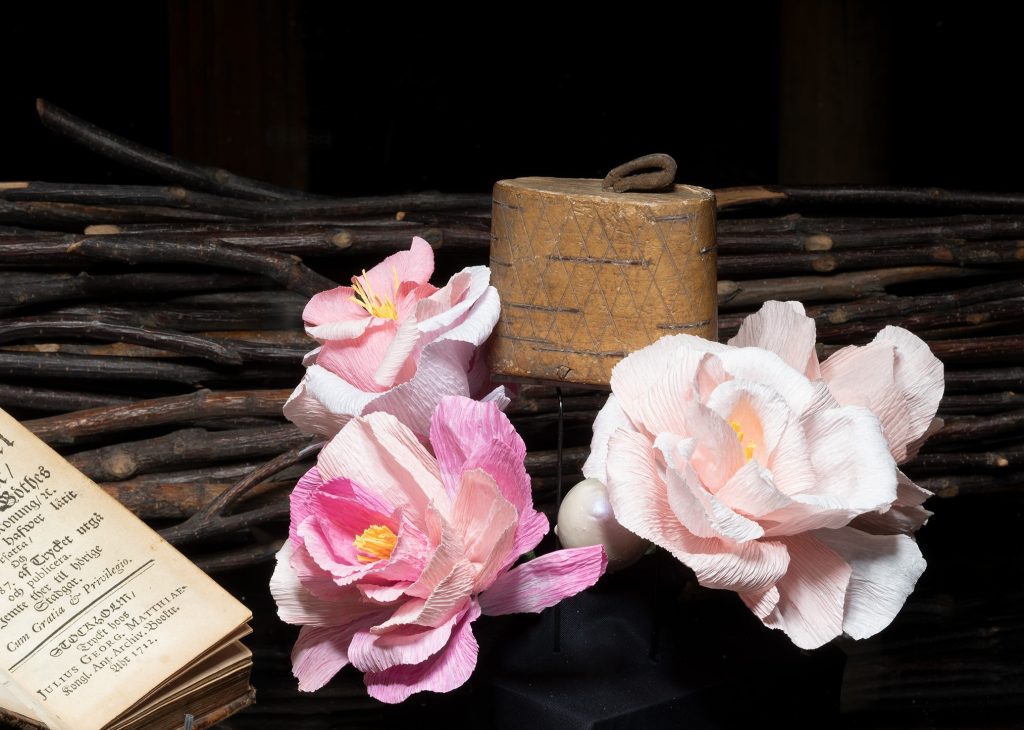
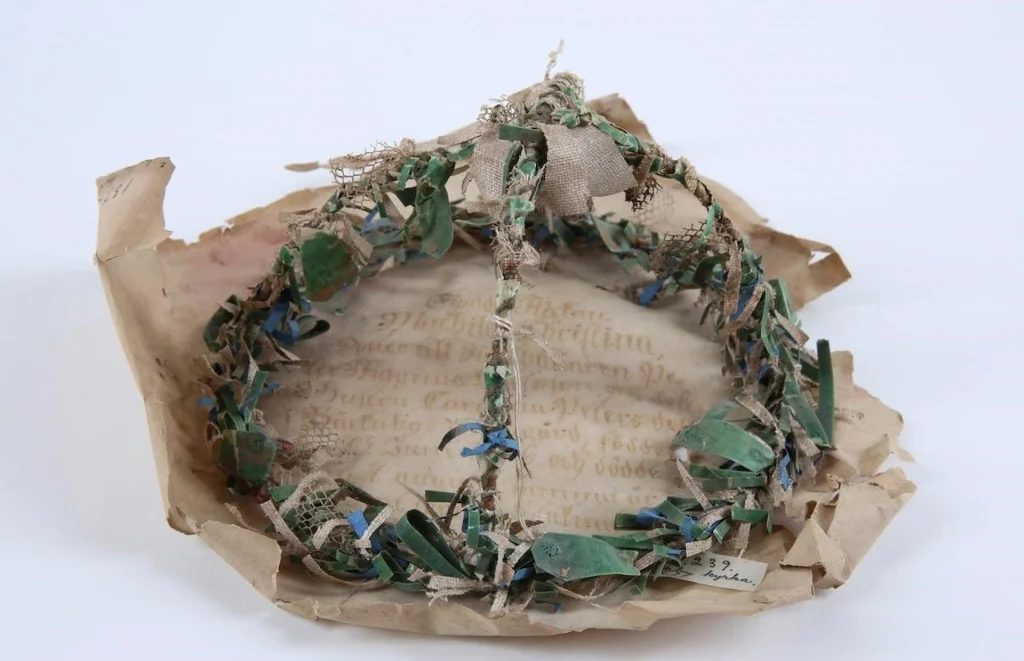
Funeral wreath for Mathilda Christina, NM.0137239
2
Funeral wreath for Mathilda Christina, NM.0137239
Not even two months old. But deeply mourned and missed.
Peter Magnus Olofson, a farmhand, and his wife Christina Petersdotter lost their infant daughter Mathilda Christina on August 7, 1846. During the funeral, this funeral wreath lay atop the small coffin, at the level of the girl’s head. It was subsequently placed as a memorial in what was then the old Bäckaby Church in Småland.
From the church records, we know that her parents called her Thilda, that she was born on June 13, and that she died of pertussis or whooping cough. That year, at least five children in the parish of Bäckaby died of pertussis. The grieving parents commemorated them with wreaths in the church, the boys’ on the men’s side, the girls’ on the north side. The wreath was donated to the Nordic Museum in 1921.
3
Portrait of a child, circa 1670–1700, NM.0093139
3
Portrait of a child, circa 1670–1700, NM.0093139
The boy in the painting is wearing a simple wrap, but the exclusive cap, the velvet drapery and the cushion with fringes and gold lace reveal his social class.
Under the sumptuary laws of the 1660s, the nobility were no longer permitted to use silver or gold in fabrics or lace, but were restricted to plain, modest linen or silk. When it was no longer possible to display their wealth through magnificent burial garments, the practice of depicting the deceased ceased.
What do people in Nordics celebrate, and how?
As a museum of cultural history, Nordiska museet documents everyday life and festive occasions in the Nordic region. For example, we research: What do people celebrate, and how? What do the traditions and rituals of yesterday and today look like? And what role do they play in our social life?
We have been gathering knowledge about traditions since the late 19th century
Since the late 19th century, we have been documenting and gathering knowledge about traditions and rituals in people’s everyday lives and celebrations, which represent festivals and traditions. This knowledge takes the form of artefacts, photographs, folk memories and transcribed interviews featuring examples of rituals and traditions.
We have also collected and documented this material through fieldwork (that is, documenting celebrations on site), sending out questionnaires, interviewing people and, more recently, through digital collections.
Traditions change and are dynamic
Over the 150 years that the collections have been in existence, there have been enormous social changes in Sweden and the Nordic region. Traditions and social patterns are also dynamic and change: traditions are born, transformed and evolve in line with people, the times and the media. We continuously analyse the material in the light of both contemporary processes and historical circumstances.
Many factors shape and change celebrations
In short, it can be said that celebrations today reflect a multitude of influences from past social structures, from our own time, from migration, as well as social, economic and technological change.
Festivals and festive celebrations in the Nordic region are strongly influenced by the Christian faith, changes in society and values. Further factors include folk and supernatural- beliefs, folk religion and folk values that can be traced back to Nordic peasant society.
Over the 150 years that Nordiska museet has been gathering knowledge about traditions and rituals linked to festivals and special days of the year, there have been enormous social changes in Sweden and the Nordic region. Traditions are born, transformed and evolved in tandem with time and it’s people.
Ritual?
Over the past 150 years, research perspectives and concepts have also changed. A key fundamental concept is that of ritual. This refers to the practical observance – what people do in connection with a festival, tradition, specific day, time of year or event. Such as eating semlor, hiding Easter eggs, lighting candles in cemeteries or going ‘trick-or-treating’.
Rituals often involve symbols, such as the Christmas tree, the Midsummer maypole, waffles and semlor, or, for that matter, the crisps and dip enjoyed during Friday nights for the ultimate “fredagsmys”.
Tradition?
You could say that a ritual becomes a tradition when people attach particular value to the ritual and the celebration, without these necessarily having to be particularly old or widespread.
This definition, too, reflects the perspective of academic research. However, in everyday speech, the terms ‘ritual’, ‘tradition’, ‘festival’ and ‘custom’ are often used interchangeably. When we talk about traditions here, we are generally referring to rituals that are particularly valued; Christmas celebrations are one example.
Religious festivals
Another important term is ‘festival’ (högtid), which refers to rituals that are more closely linked to religious calendars. In the Nordic countries, the Christian calendar has dominated, but other religious calendars play an important role as well.
The boundary between religious calendar rituals and secular rituals appears to be becoming increasingly blurred, reflecting the secularisation of society. Most people in Sweden celebrate religious festivals without paying attention to their religious connection.
Annual festivals and life-cycle celebrations
In addition to the church calendar, festivals have historically been shaped by the rhythm of the farming year and agriculture. These are known as annual festivals or calendar rites.
Many festivals are linked to the human life cycle, where church rites have been, and remain, of great significance.
However, as society changes, so does the significance of these rituals. Although many people are still baptised today, it is not uncommon for this to take place through non-church naming ceremonies.
Ever-changing and dynamic
One of the most important insights into rituals and traditions to emerge from research is that they change. Certain particularly transformative social changes have left a clear mark on both everyday life and on rituals and festivals.
Perhaps the most significant from a cultural-historical perspective are the role of the church, as well as urbanisation, democratisation, the welfare state and the pursuit of social justice.
Contemporary life and tradition
As the Nordic countries became increasingly urbanised, economic conditions changed. People were no longer producing goods simply to provide for themselves. The family was transformed into a unit of consumption, able to purchase all the goods marketed in connection with festive occasions.
Traditions and festivals follow people’s movements between communities. Some are upheld, others fade away, and some take on a different meaning.